If you've noticed gritty, sand-like material in your gutters or scattered around your downspouts, you've found granules from your asphalt shingles. Some of that is completely normal. A meaningful amount of it is a warning sign. The difference between the two is exactly what every qualified roofing contractor is trained to assess, and what most homeowners have no framework for evaluating on their own.
This post breaks down what granules do, what causes them to shed faster than they should, and how to interpret what you're seeing on your roof or in your gutters. GAF notes that granules are one of the primary UV-protection components built into asphalt shingles, and that their presence directly affects how well a roof handles the elements over time.
What Granules Actually Do
Asphalt shingles are built in layers. At the base is a fiberglass mat that provides structural integrity. That mat gets coated with asphalt for water resistance and flexibility. The granules, small ceramic or mineral particles, are embedded into the surface of that asphalt layer during manufacturing.
Those granules do three things. First, they block UV radiation from reaching the asphalt beneath them. Asphalt exposed to direct sunlight breaks down, gets brittle, and starts cracking. The granule layer is what extends shingle life by shielding that asphalt from the sun. Second, they absorb impact from hail, debris, and foot traffic, distributing the energy rather than letting it concentrate on the asphalt. Third, they're part of what gives asphalt shingles their Class A fire rating.
When granule coverage is intact, a shingle can do its job for its full rated lifespan. When that coverage breaks down, the asphalt is exposed to stresses it wasn't built to handle directly, and deterioration picks up fast.
Normal Shedding vs. Premature Loss: How to Tell the Difference
Some granule shedding is expected and not a sign of anything wrong. In the first few months after a new roof replacement, manufacturing excess granules work their way off the shingle surface and wash into the gutters. You'll see a noticeable deposit shortly after installation that tapers off within the first season. That's normal and doesn't indicate a product defect or installation problem.
What you don't want to see is granule loss appearing mid-life or on an older roof, especially if it's uneven, concentrated in specific areas, or visibly getting worse over time. A roof in its second decade that's consistently shedding granules isn't losing manufacturing excess. It's losing protection, and that process doesn't reverse itself without replacement.
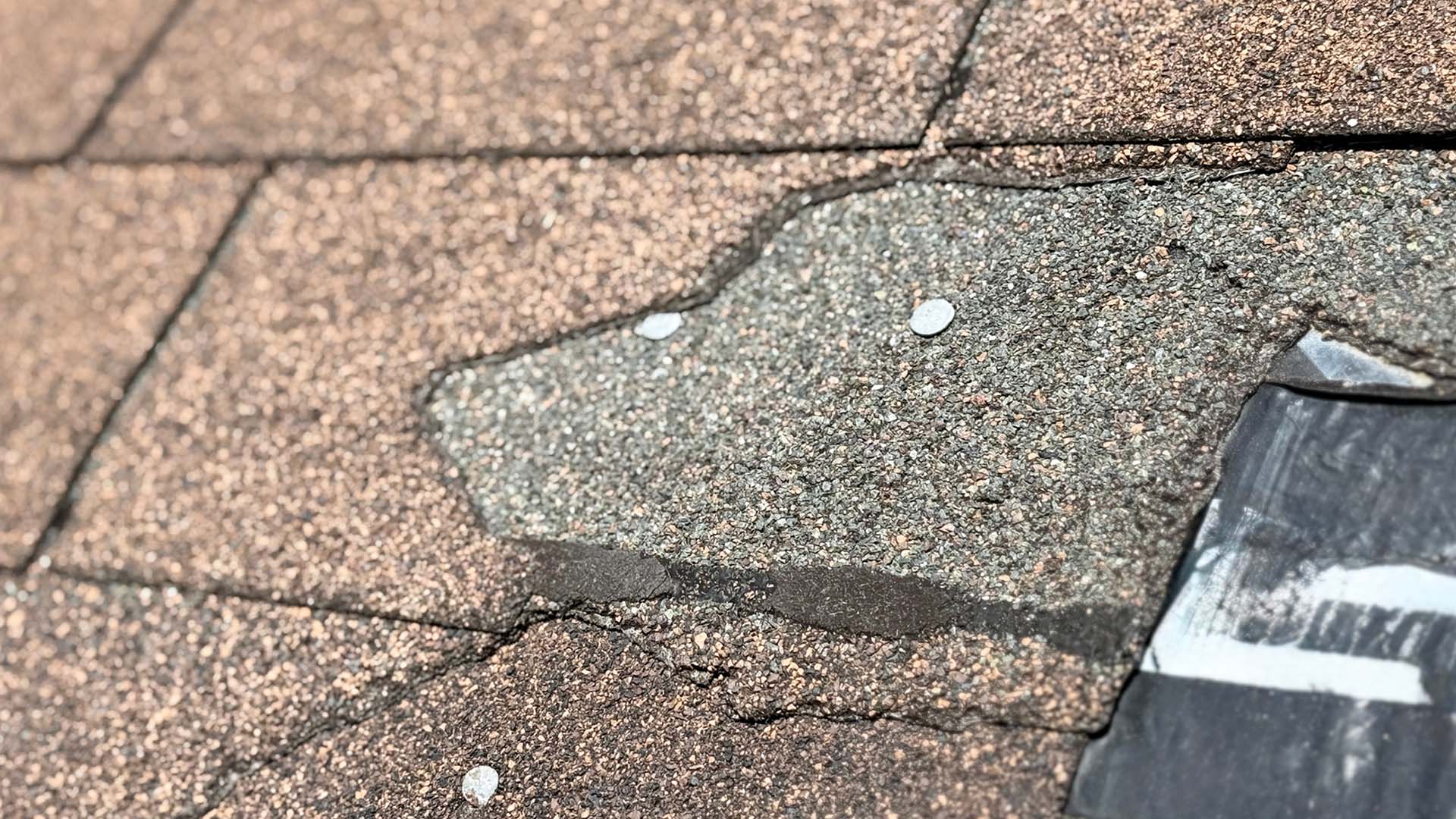
The clearest visual indicator is exposed asphalt. When granule loss reaches the point where you can see bare, dark patches on the shingle face, the UV protection in those spots is gone. Those patches will crack and blister faster than the rest of the shingle, and water infiltration risk goes up significantly at those locations.
The Five Most Common Causes of Accelerated Granule Loss
Not all granule loss has the same cause, and figuring out what's driving it requires an actual inspection. That said, these five causes account for the majority of premature granule loss cases across Wisconsin, Illinois, and Florida.
- Age and natural weathering. Shingles rated for 25 to 30 years start showing meaningful granule loss in the final third of their life. If your roof is 20 or more years old and shedding granules, the conversation should be about replacement timeline, not patch repairs.
- Hail and storm impact. Hailstones knock granules loose at the point of impact, leaving circular bare spots that look different from age-related shedding. One significant hail event can cause damage that's invisible from the ground but obvious to an inspector up on the roof. In Wisconsin and Illinois, this is the leading driver of insurance claims for roof damage.
- Poor attic ventilation. Inadequate airflow traps heat under the roof deck, raising shingle surface temperatures well above ambient. That chronic heat accelerates the breakdown of the bonding agent holding granules in place. Ventilation-related granule loss tends to show up evenly across the whole roof rather than in concentrated spots.
- Improper installation. Shingles fastened in the wrong spot, with insufficient overlap, or without proper sealing are subject to granule loss from wind lift and stress at the fastener zones. Installation-related loss typically shows up in lines that correspond to fastening patterns.
- Foot traffic and physical abrasion. Walking on a shingle roof without the right technique displaces granules at every contact point. HVAC techs, satellite dish installers, and homeowners who've been on their own roof can create concentrated granule loss that shortens shingle life in those areas.
How to Spot Granule Loss From the Ground
You don't have to get on the roof to get a sense of whether granule loss is happening. The two most reliable ground-level indicators are your gutters and the ground around your downspout outlets.
After a heavy rain, significant gritty deposits in the gutters point to active shedding. If you're already searching for roofing companies near me and scheduling consultations, check your gutters beforehand. It gives you specific information to bring to the conversation.
You can also read the roof surface from the ground with binoculars or from a clear sightline in the driveway. Look for darker patches where the shingle surface is no longer uniform in color, which means exposed asphalt. Watch for areas where shingles look thinner or flatter compared to adjacent sections, or where the coloring is uneven across a slope that should be consistent.
What you can't assess from the ground is what's happening at the fastening zones, in valleys, and around penetrations, which are all high-risk areas. A ground observation tells you whether an inspection makes sense. It doesn't replace one.
The Stages of Progression and What Each One Means
Granule loss moves through recognizable stages, and the right response depends on which stage a given roof is at.
- Stage 1 - Surface sheen loss. Shingles start to look flatter and smoother than when they were installed. Granule coverage is thinning but still mostly intact. This is normal aging for a mid-life roof and calls for monitoring, not action.
- Stage 2 - Visible thinning and early bare spots. Shingles show noticeably thinner coverage in places, with isolated bare spots where the asphalt is starting to show. A professional inspection at this stage gives you a clear read on how much life is left and whether the pattern suggests a specific cause.
- Stage 3 - Significant bare patches and asphalt exposure. Multiple shingles have exposed asphalt on their face. UV degradation is accelerating in those areas. Cracking and blistering usually follow within a season or two. Start planning for replacement now.
- Stage 4 - Widespread failure. Granule loss is extensive across multiple slopes. Shingles are cracked, curling, or blistering. Water infiltration is a current risk, not a future one. Replacement is urgent.
How Granule Loss Behaves Differently in Wisconsin and Florida
The pressures that drive granule loss in Wisconsin are genuinely different from what drives it in Florida. Understanding the regional pattern helps you make sense of what you're seeing.
In Wisconsin and northern Illinois, hail is the primary driver of premature granule loss. The region sees multiple significant hail events every year, and the damage compounds across seasons. A roof that shows moderate granule loss after each storm might not trigger an insurance claim at any single point, but the accumulated damage can reach a tipping point where replacement is warranted. Freeze-thaw cycling also stresses granule adhesion over time: water that gets into micro-gaps can freeze, expand, and physically dislodge granules from the asphalt surface during winter.
In Tampa and Clearwater, sustained UV exposure is the main accelerant. Florida gets intense, year-round direct sun that degrades asphalt faster than Northern markets. Roofs that reach their full 25-year life in Wisconsin might show serious granule loss by year 15 or 16 in a Florida climate. Hurricane-season wind and debris then add impact damage on top of the baseline UV wear, compressing the timeline further.
What a Roofing Contractor Should Tell You After an Inspection
A roofing contractor inspection for granule loss should give you specific, documented answers, not a general impression. The National Roofing Contractors Association has good consumer guidance on what a professional roof inspection should include and what you should receive in writing afterward.
After a granule loss inspection, you should walk away with specific answers. Here's what a good inspection covers:
- What stage of granule loss is the roof at, and does the pattern point to a specific cause like hail, ventilation failure, or installation problems?
- Are there areas of exposed asphalt that create an immediate water infiltration risk, or is the loss at a stage where the roof can be monitored for now?
- Is the pattern spread across the whole roof or concentrated in specific slopes or areas, and what does that distribution mean?
- What's the estimated remaining functional life of the current roof given what was found?
- If replacement is needed, is the timeline urgent or can it be planned out over the next one to two seasons?
A contractor who can't answer those questions specifically, or who jumps straight from 'I see granule loss' to a replacement pitch, isn't giving you the inspection you need.
How Ridge Top Assesses and Communicates Roof Condition
Ridge Top Exteriors provides free roof inspections across Wisconsin, northern Illinois, and Tampa/Clearwater, Florida. When you search roofing companies near me, you deserve a contractor who shows up, documents what they found, and tells you honestly whether to act now or keep an eye on it. That's the standard we hold ourselves to on every inspection.
Our residential roofing assessments cover granule loss staging, ventilation evaluation, flashing condition, deck integrity where observable, and a written summary with a recommended action timeline. If your roof has life left in it, we'll tell you that and explain what to watch for. If it doesn't, we'll show you the evidence and walk you through your options. Use our instant quote tool if you're already ready for a number.
Read verified reviews from homeowners across our service area or learn more about how our inspection and project process works before you schedule.
Granule loss that's reached Stage 3 or 4 isn't something to manage with another inspection cycle. It's something to act on before the next Midwest winter or Florida storm season. If you're not sure which stage you're looking at, that's exactly what we're here to figure out with you.