Most homeowners think about their roof twice. Once when they replace it and once when it starts leaking. Everything that happens in between, the granule loss, the first failed pipe boot, the seal strip that breaks in a windstorm, the ice dam damage at the eave, goes unnoticed. That invisibility is expensive.
Roofs don't fail all at once. They fail in stages, and each stage is less expensive to address than the next one. The National Roofing Contractors Association recommends professional roof inspections at least every two years and after any significant storm event. The reason is straightforward: a qualified roofing contractor can identify problems at stages where they're still manageable, not just at the point where they've become urgent.
Here is what those stages look like, in order, on a roof that no one is watching.
Why Roofs Fail Gradually, Not All at Once
A roof is a system made of multiple components, each with its own vulnerability and degradation timeline. Pipe boots made of neoprene rubber degrade from UV at a different rate than the shingles above them. Flashing sealants crack and pull away from surfaces years before the shingles show visible wear. Granule coverage thins incrementally rather than disappearing overnight.
The problem with gradual failure is that no single event triggers the response that obvious failure would. A slow-leaking pipe boot that puts a cup of water a week into the wall cavity doesn't announce itself with an interior drip until months or years after it starts. By the time the homeowner notices anything, the water has been working on the framing for a long time.
Stage 1: Normal Aging (Years 1-8)
In the first eight years after a quality residential roofing installation, a properly installed roof should require no significant intervention. This is the period of maximum warranty protection and minimum risk.
Some things to be aware of during this window: manufacturing excess granules shed in the first season, which is normal. Sealants at penetrations need to be checked after the first few years as they cure and settle into their long-term condition. And storm events should prompt a visual check, even if the roof looks fine from the ground.
The biggest mistake homeowners make in Stage 1 is assuming that a new roof means no attention for 25 years. Even a quality roof installed correctly benefits from knowing what condition it's in after the first significant hail or windstorm.
Stage 2: Early Warning Signs (Years 8-14)
Between years 8 and 14, a roof enters the period where early warning signs can appear if conditions have been demanding. In Wisconsin and Illinois, this is when hail accumulation starts to show in granule coverage patterns. In Florida, this is when UV-driven degradation begins to be measurable.
What a professional inspection at this stage finds depends on the roof's history. A roof that has absorbed two or three significant hail events may be showing measurable granule loss on south and west slopes. Pipe boots that were installed without replacement at the original job may be showing cracking. Caulk at penetrations may be pulling away.
The cost to address issues at this stage is minimal. A pipe boot replacement costs a fraction of a full roof replacement. Resealing penetrations is a simple maintenance task. A roofing contractor who identifies these issues at Stage 2 is saving the homeowner significant money relative to discovering them at Stage 4.
Stage 3: Active Deterioration (Years 14-18)
By years 14 to 18, a roof that has been ignored is showing visible signs of wear, though many of them are still below ground-level visibility. Granule coverage on the most exposed slopes is thinning meaningfully. Seal strips on shingles in vulnerable areas may have failed, leaving those courses vulnerable to wind uplift in the next significant storm.
At this stage, the questions shift from maintenance to planning. A professional inspection at year 14 to 16 on an asphalt shingle roof gives the homeowner a realistic remaining life estimate and a clear sense of whether they're planning a replacement in two years or five. That planning window is the difference between a replacement that happens on the homeowner's schedule and one that gets forced by the next bad storm.
Without professional attention at this stage, the homeowner has no information. They're operating on assumption, and assumptions about roof condition tend to be more optimistic than reality.
Stage 4: Water Infiltration Begins (Years 18-22)
This is the stage where the costs escalate and the decision window closes. One or more components of the roof system have failed to the point where water is entering the wall or attic assembly. A pipe boot that was cracking at Stage 2 is now open at the base. A flashing seal that was failing at Stage 3 is now letting water work behind the counter flashing at the chimney. A shingle that lost its granule coverage is now cracking.
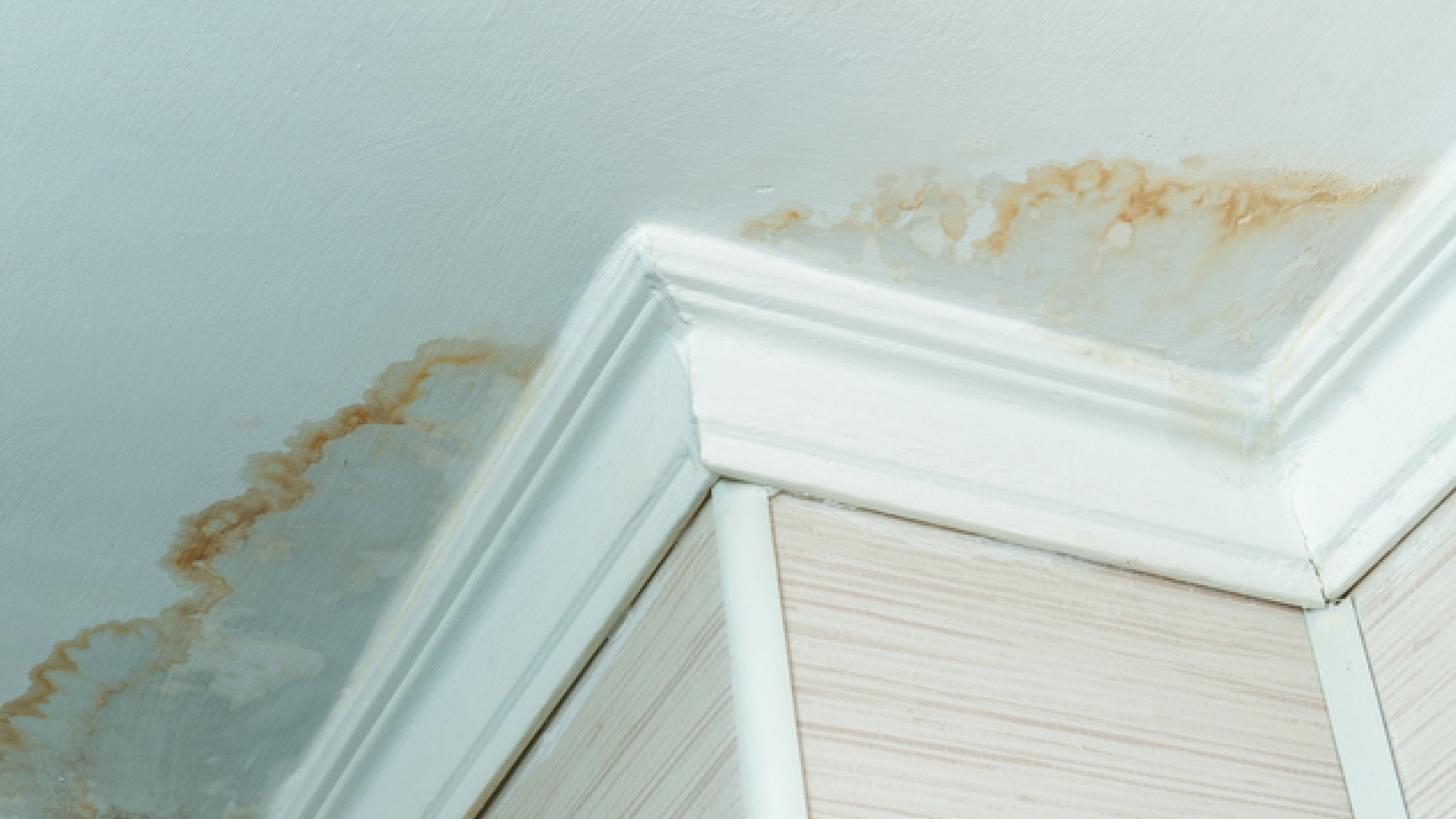
Water in the wall cavity starts the rot and mold process. It doesn't stop when the rain stops. Moisture trapped in wood framing and insulation continues to damage the substrate between rain events. The longer it goes undetected, the larger the affected area.
A roof replacement at this stage still fixes the problem, but it's no longer just a roof replacement. It's a roof replacement plus deck repair in the affected areas, plus potentially insulation replacement in the attic sections where moisture has reached. The total project cost is meaningfully higher than a planned replacement at Stage 3.
Stage 5: Structural Damage (Year 22 and Beyond)
A roof that has been actively infiltrating water without intervention for several years can reach Stage 5, where the damage has progressed from the deck into the structural framing. Rafter tails that have been exposed to moisture cycling can rot. Fascia and soffit boards that have absorbed years of water intrusion require replacement. In severe cases, structural sheathing degradation affects the integrity of the roof plane itself.
At this stage, the project is no longer a roofing project. It's a roofing project with significant structural repair components, which brings in carpentry and framing costs on top of the roofing scope. This is the most expensive version of a roof problem, and it almost always traces back to a condition that was present at Stage 2 or Stage 3 and simply went unaddressed.
What Each Stage Costs to Address
The cost progression isn't linear. A Stage 2 repair, sealing penetrations and replacing a pipe boot, might run $300 to $600. A Stage 3 planned replacement, on the homeowner's schedule with time to evaluate contractors and select materials, is a straightforward project. A Stage 4 replacement with deck repairs adds thousands to the total. A Stage 5 replacement with structural framing work can add tens of thousands.
The delta between catching a problem at Stage 2 and addressing it at Stage 5 is one of the clearest return-on-investment cases in home maintenance. Professional inspection costs are minimal. The cost of the information they provide is almost always returned many times over.
The Case for Professional Attention Before You Need It
The homeowners who manage their roofs best are the ones who treat inspection as a routine, not a reaction. They schedule a professional assessment every two or three years, they get inspected after significant storms, and they have documentation of their roof's condition that informs their planning.
When they decide to replace, it's because a professional told them Stage 3 was approaching and the planning window was open. Not because a Stage 4 leak forced their hand in November.
A good roofing contractor isn't just someone who replaces roofs. They're someone who helps homeowners understand where their roof is in the progression and what the right response is at each stage. That's the relationship Ridge Top builds with every homeowner across our service area.
How Ridge Top Approaches Proactive Roof Care
Ridge Top Exteriors provides free roof inspections across Wisconsin, northern Illinois, and Tampa/Clearwater, Florida. Our inspections are documented with photographs, produce written findings, and include honest recommendations that reflect the actual stage of the roof, not a default recommendation to replace.
If your roof is between 8 and 14 years old and hasn't been professionally assessed recently, that's the window where a Ridge Top inspection is most valuable. Search roofing companies near me on ridgetopexteriors.com to find our nearest location, or use our instant quote tool if you already know a replacement is coming.
Our roofing service page covers what we inspect and install, and our process page explains how we manage every project from first contact through completed installation. Read verified reviews from homeowners across our service area to see how Ridge Top's approach plays out in practice.
The best time to look at your roof is before something forces you to. The second best time is right now.